
Therapy Dogs
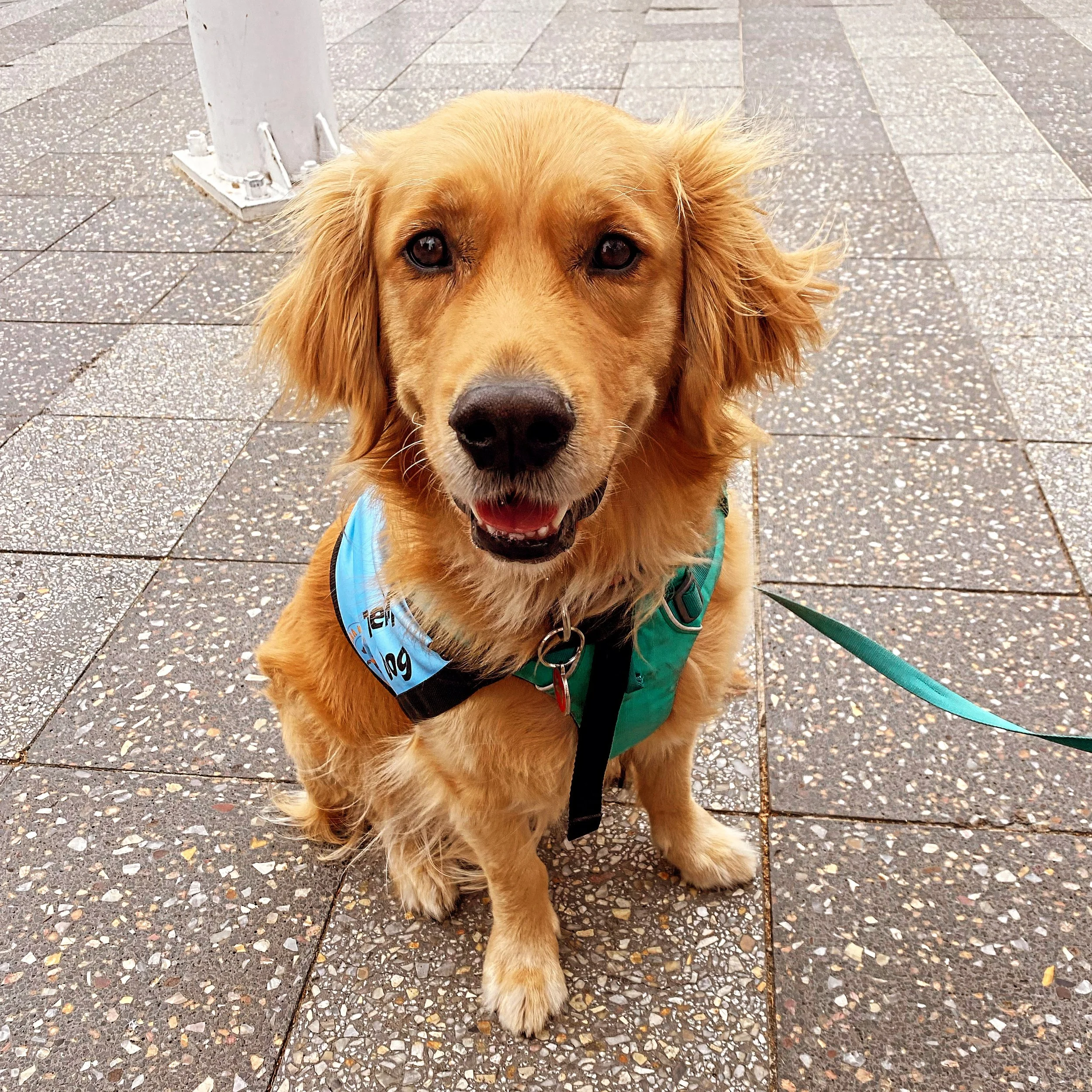
Therapy dog courses
For professionals and community volunteers
Therapy dogs are dogs that are trained and assessed to have safe, positive interactions with vulnerable persons with the goal of providing beneficial therapeutic outcomes to those that they engage with. Most commonly they visit places including hospitals, aged care facilities and schools. Through interactions with dogs, many find it beneficial to their health and well-being. Professionals such as teachers, social workers, psychologists, counsellors, youth workers and other allied health professionals, find the introduction of a trained, sociable dog beneficial to the people they support.
You may be working as a professional in a school setting, private clinic, hospital, or other setting, and feel your dog might be suitable to work as a therapy dog alongside you to help bring about greater outcomes for the people you work with. It may be though that you’re interested in doing some volunteer work within an organisation such as aged care.
If you are considering volunteering with an organisation to do community visits with your dog, there are amazing organisations that run community therapy dog programs such as Delta Therapy Dogs, and Lort Smith’s pet therapy program among many others, where they have their own assessment procedures that they conduct and provide their teams with insurance, uniforms etc for working with them. If this is of interest, you’re absolutely still more than welcome to undertake my training course, however please keep in mind that successful completion of my course will not mean that you won’t have to undertake a specific organisation’s own assessment process again, and undertaking this course won’t mean that you will be accepted to work with these organisations. Doing a therapy dog and handler course also doesn’t automatically mean you can enter an organisation to do work with them. Therapy dog training and assessment is not legally protected, regulated or have legislated criteria as assistance dogs do. If you would like to independently take your dog into a setting and they have asked for you to be able to provide evidence of training and assessment, then our community visits and volunteers course is for you!
Other organisations that recruit paid professionals from a vast range of educational and professional backgrounds to work with them providing structured programs across settings such as schools, may require you to have completed a thorough, professional program of training and assessment first. This is where this course comes in! Although completing this course does not guarantee you employment with an organisation, our course is fast becoming one of the most respected programs for therapy dogs and handlers in greater Melbourne and beyond.
What do we offer?
Our therapy dog and handler - professionals course, is popular with professionals wishing to undertake Animal Assisted Treatment programs within their work. Common professions include teachers, psychologists, OT’s, speech therapists, social workers, counsellors and wellbeing staff, and much more. Programs including therapy dogs require greater program planning, education and training. We offer a theory component to our program to ensure that you’re ready to professionally include such a program within your workplace setting. The practical training to ready your dog to work with you can vary depending on your dog’s training history. We recommend that your dog has a minimum of basic skills and manners training prior to undertaking the course. This would include training in settling on a mat, coming when called, walking politely on lead, wait/stay, greeting people politely, leaving objects when asked, and being calm in distractions. We also want to see dogs that are very prosocial to strangers and genuinely enjoy interacting with people.
Our assessment that’s included within the overall three-day training program is modelled on the best practice standards recommended by that of Therapy Dogs International and also the public access test for assistance dogs (please note that therapy dog assessments do NOT entitled the dog to have public access following completion. It is not a public access test that is conducted for therapy dogs and therapy dogs are not entitled to public access). All content included within the training course is also modelled on the best practice standards available internationally for the training, handling and practices of Animal Assisted Services. This includes policies and documentation, dog welfare and behaviour, work limits for the dog, environmental conditions and management for safety, risk management, positive training and ethical, consenting interactions between clients and dogs, and much, much more.
All of our training for both therapy dogs and assistance dogs are undertaken using force free methods. Yes we use play, food and all of our training is about ensuring an ethical approach to dogs working with us and our dogs being treated as a colleague rather than a tool.
Please note that we do not currently reassess teams that have been trained under other organisations. This is to ensure that teams wearing our logo adhere to our training standards, and most importantly that relates to welfare and ethical treatment of dogs and participants.
Click here to view our therapy dog suitability assessment checklist.
Click here to read our brief summary on what to expect from the therapy dog program, including what to expect to learn, what’s included in the assessment and more.
If you have ticked yes to all of the points in the above checklist document and wish to register for an upcoming course, please complete the course registration form below and return it via email to laura@mundydogs.com.au
Click here to download the course registration form for the PROFESSIONALS PROGRAM
Click here to download the course registration form for the COMMUNITY VISITS
Click here to download the veterinary assessment form for your dog
Click here to download our comprehensive guide for prospective therapy dog handler and dog teams.
Therapy Dog and Handler Training and Certification courses:
Before booking into a course, we recommend that you read our suitability checklist above and make sure you say ‘yes’ to each of the points listed. You may even wish to consider booking in a meet and greet session with me to meet your dog and go over what you hope to achieve with training. This session gives you the opportunity to see where your dog is at with their training and get an assessment done on your dog’s temperament and social behaviour if you’re unsure if you’re ready to commit to the course. These sessions are great if you have a pupster or a younger dog that’s under 12 months and you want some help in training them in readiness for this course.
What might we cover in a meet and greet?
You may want to know first whether your dog is likely to be suitable for this type of training and work, or whether you might benefit from attending some foundation training before starting training.
What we cover in this session is:
Does your dog genuinely like interacting with unfamiliar people? Do they get intrinsic enjoyment from socialising and touch with strangers?
Does your dog appear comfortable with touch? Is there are sensitivity to touch or handling?
Acceptance of odd behaviour, verbal outbursts, sudden noises, things that move fast, the presence of other dogs, people of all sizes and ages etc.
Presence of any aggression/over reactivity. We assess thresholds for using any forms of aggression around resources, touch and handling, and people and other animals.
Does your dog enjoy working? We want to see dogs that love working and engaging in training. Our training does NOT involve any forms of compulsion or force. We also insist that there is reinforcement used. This is not just in the form of praise or affection, it must include food and/or play (primary forms of positive reinforcement to an animal), praise is not enough. This is best practice standards in the practice of animal assisted interactions and assistance dogs.
Assessing the level of your dogs training. Your dog may be very advanced in training, or they may be very new to the game! We will assess where you are at and how much training you’re likely to need moving forward.
Training plan development. We may suggest your dog undertakes some basic training classes either with us or with another of our recommended training schools. This training will be to get some foundation training skills prior to doing the therapy dog training program.
*** Please note that completing an application form or doing a meet and greet session does not guarantee that you’ll be suitable to enrol in the therapy dog course. This assessment does not include the cost of the training program nor does the fee get taken off the cost of the rest of the program.
This session is $295 (goes for approximately 1.5-2hrs). If the session is shorter, a discounted rate will be applied.
** Please note that booking into the course suggests that your dog is :
Sociable with new people and other dogs.
Displays no aggression to people or other dogs.
Is not a dangerous dog or been declared a dangerous dog.
Has achieved a basic level of training skills using positive reinforcement methods of training.
Your dog is aged under 10 years and has no health concerns which would make therapy dog work not suitable.
Therapy Dog and Handler Certification - Level One: Community Visits
This one day course, including assessment, is aimed at community members and their dogs that require a training and assessment prior to being able to attend organisations to do visitations with their dogs. This day of training and assessment will include crucial components such as body language and stress signals in your dog, the importance of risk management and consent, how to ensure safety of your dog and participants, matching your dog with different settings and populations, disease risk and hygiene requirements, dog training and behaviour needs, and a comprehensive assessment of temperament and behaviour.
This course is $495 and includes a therapy dog bandana along with a letter of assessment and certificate upon successful completion.
Reassessment is required every 12 months and can be completed one on one or through attending group reassessment sessions regularly held throughout the year.
Therapy Dog and Handler Certification - Level Two: Professionals
This three-day comprehensive training and assessment course includes theory modules (e.g. program planning, risk management, dog behaviour and training, how to include therapy dogs in your work and much more) as well as the practical training with your dog and assessment. This course is structured for professionals wishing to include their dogs in goal-directed, therapeutic and ethical ways within their work. The course aligns with best practice standards and we proudly follow only ethical, force-free and all participant-focussed practices (the client, the dog and the handler). We have a strong focus on clinical applications and the evidence available for the inclusion of animals.
Course information:
The course length is approximately 21 hours. This is split over three days of learning and a written assessment to be completed and returned after the training.
Key learning objectives include:
What are therapy animals and how to do their roles differ to assistance animals.
Animal Assisted Services (AAS) terminologies and classifications.
Settings and professions therapy dogs may be included in.
Research of how therapy dogs may be of benefit to different presentations and why.
Matching appropriate clients to work with your therapy dog.
Activities that could be useful and why.
Important documentation: Risk assessments, procedures, policies, proposals etc.
Body language of dogs and the importance of being fluent in speaking your dog’s language.
Consent, ethics, welfare (for humans and dogs).
Dog training and behaviour basics.
Temperaments of dogs and personalities. Why variety is good and how it can be of benefit.
Behaviour on site when providing mobile services.
General skills and manners including settling on mats, recalls, loose lead walking, greeting behaviours, polite movement around spaces, managing relationships within the rooms and across organisations as a whole.
Dog equipment and handling.
Setting up environments to be safe for clients and your dog(s).
Associations that exist to support AAS practices, and best practice standards and guidelines available.
Assessment of your dogs behaviour and temperament.
Health checks and your dog’s response to touches over the body.
Advocacy for your dog and how to do it in professional settings and relationships.
Balancing the role of dog parent and professional handler plus educator or clinician.
Managing dog in an emergency.
How to assess suitability of clients before including your dogs.
Referral processes for inclusion in Animal Assisted Services (AAS).
How to include your dog indirectly if your dog is sick or unable to work.
Selecting a dog as being suitable for inclusion in a therapeutic role.
and much more….
This course is currently run in Altona with views to run additional courses around Melbourne and regional areas in the future. Keep an eye on our booking page and socials for where and when a course may be running near you.
This intensive course is $1495
Included is a copy of all course slides, a bandana for your dog upon successful completion of the assessment, a certificate and letter of assessment. on the final day of the course. You will be invited to join our closed Facebook group for working therapy dog teams which is moderated by myself at all times and am available to answer questions there as needed.
You can request to have a vest with our logo to use on your dog or you may choose to make your own vest or bandana in your work colours for example. If you choose to have one of our vests, these can be purchased through us and are custom printed with your dog’s name on it by Blackdog Melbourne.
Note that we suggest you undertake a yearly reassessment of your dog as per best practice guidelines recommend.
This annual assessment is $295 (Approx. 2hrs. Cost is for if the assessment is completed in our service area - travel fees may apply if you want your assessment undertaken at your workplace or another area upon request) if undertaken privately. Group recertifications (half day of training and assessment. Cost is $250 and are held throughout the year based on demand from teams being due.
If you wish to undertake all practical training and assessment on a one on one basis, this can be made available and an individual training plans and costings can be developed for you.
Please note that no training tools such as head halters or correction chains may be used either in training or at the assessment. Food is allowed in the assessment and is strongly encouraged (if suitable - obviously some settings may be more challenging than others and this can be discussed within your training). No hitting, smacking, yelling, force, compelling/forcing physically into position, no hands on body to push into positions, or any aversive interactions are allowable at all. Reading of stress signals and our dogs’ other forms of communication is also assessed.
Booking process
If you wish to book in for the either of the therapy dog and hander certificate courses, please download the course registration form and complete your information including the course date you’re registering for. When booking into our therapy dog and handler certification program you understand that it does not guarantee that you will complete the training having passed the assessment process. Our suitability checklist is aimed at determining whether there are any concerns that may mean your dog may not be suitable for working in this role. The outcomes of doing this program may be that we deem your dog is not suitable for therapy dog work, that they may not be ready yet and we can work with you in training that will help prepare your dog to undertake the assessment again at a later date, or that you graduate as a successful team. If you’re unsure if this training may be suitable for you and your dog please reach out with any questions via email at laura@mundydogs.com.au or call 0412732771
Upcoming course dates for 2026: **updated August 2026
Note that all courses will be run at The Pines Scout Camp, Altona.
Therapy Dog and Handler Course - Professionals:
Friday the 20th November (online) and Friday’s 27th of November and Friday 4th December 2026 (in-person in Altona) - SOME SPACES STILL AVAILABLE
Therapy Dog and Handler Course - Community Visits
Keep an eye out for more course dates to be released. Contact us to register interest.